What is the Importance of Conductor Number in Your Life Paths?

Numbers play an important role in astrology. It has a different stream of practice known as numerology, where specific numbers play a major role in shaping your destiny. The concept of a conductor number or a life path number is vital, as it acts as a cosmic conductor that creates your purpose, personality, and life trajectory.


What is a Conductor Number and Why is it Important?


You can find your conductor number through a simple calculation. A professional astrology service in Kolkata can help you in the process, as they calculate the number by reducing the components of your birth date to a single digit. Here, we will discuss in detail why this number matters for making vital life decisions.


  • Self-Discovery: By knowing your conductor number, you will receive clarity about innate traits and behavioural patterns. It also helps you understand the deeper calling of your soul. With these, you can identify your true self.
  • Relationship: Your conductor number can significantly impact how you interact with others. It has the power to shape your relationship dynamics, whether with family or your significant other. With a conductor number, you will gain awareness of your emotional language and communication style. As a result, you can prioritize your relationships and communicate effectively.
  • Personal Growth: When you improve your interactions and communication style, you automatically take a step towards personal growth. Your conductor number can function like a compass, taking you through the turning points of your life. You will get insight into your lessons and make adjustments accordingly.


These are some of the vital roles that a conductor number plays in your life. To learn more about this concept, you can visit a professional astrology service in Kolkata. Contact Astrologer Shree Somok, who have high reputation as an astrologer in the city. He offers trusted Vedic astrology guidance, which can help you go through the challenges of life with clarity and confidence. To learn more, you can contact him today.

Vedic Astrology vs Western Astrology: Key Differences Explained

Vedic Astrology vs Western Astrology: Key Differences Explained

Astrology is practiced in different forms across the world, but the two most commonly discussed systems are Vedic astrology and Western astrology. While both aim to understand human life through planetary movements, their methods, calculations, and interpretation styles are quite different.

This article explains the key differences between Vedic and Western astrology in a clear and practical way, helping readers understand which system works better for prediction, guidance, and real-life decision-making.


Origin of Vedic Astrology

Vedic astrology, also known as Jyotish Shastra, originated in ancient India and is deeply rooted in Vedic philosophy. It focuses on karma, life purpose, and timing of events.

This system was developed to help individuals:

  • Understand life patterns
  • Prepare for upcoming phases
  • Take corrective actions when needed

Vedic astrology is traditionally used for guidance related to marriage, career, health, and spiritual growth.


Origin of Western Astrology

Western astrology developed primarily in ancient Greece and later evolved in Europe. It focuses more on psychology, personality traits, and emotional tendencies.

Western astrology is often used for:

  • Understanding personality
  • Compatibility analysis
  • Daily horoscopes
  • Emotional and behavioral insights

It is widely popular in newspapers, magazines, and online platforms.


Zodiac System: Sidereal vs Tropical

One of the biggest differences between the two systems is how zodiac signs are calculated.

Vedic Astrology – Sidereal Zodiac

  • Based on the actual position of constellations in the sky
  • Accounts for the precession of equinoxes
  • Results in different planetary placements compared to Western charts

Western Astrology – Tropical Zodiac

  • Based on seasons rather than star positions
  • Zodiac signs remain fixed according to calendar dates
  • Does not adjust for astronomical shifts

This difference alone can completely change a person’s birth chart.


Prediction Approach: Timing vs Psychology

Vedic Astrology

  • Strong focus on timing of events
  • Uses planetary periods (Dashas)
  • Highly effective for predicting life phases such as marriage, career changes, and major transitions

Western Astrology

  • Focuses more on personality and inner psychology
  • Limited emphasis on exact timing
  • More interpretative than predictive

This is why Vedic astrology is often preferred for future-oriented guidance.


Role of Planets and Houses

In Vedic astrology:

  • Each planet has a specific karmic role
  • Houses represent concrete life areas
  • Planetary strength and dignity are deeply analyzed

In Western astrology:

  • Planets are interpreted more symbolically
  • Houses focus on emotional and behavioral themes

Both systems use planets and houses, but the depth of analysis differs significantly.


Accuracy and Practical Application

Accuracy depends on purpose.

  • For self-understanding and emotional awareness, Western astrology can be helpful.
  • For life decisions and future planning, Vedic astrology is generally more precise.

Vedic astrology’s use of Dashas and transits makes it better suited for answering questions like:

  • When will marriage happen?
  • Is this a good time to change career?
  • Why is a difficult phase repeating?

Which Astrology System Is Better?

There is no universal “better” system — it depends on what you are seeking.

Choose Vedic astrology if you want:

  • Predictive clarity
  • Timing of events
  • Practical remedies
  • Long-term life guidance

Choose Western astrology if you want:

  • Personality insights
  • Emotional understanding
  • Psychological patterns

Many people find value in understanding both systems, but rely on Vedic astrology for major decisions.


When Vedic Astrology Works Best

Vedic astrology is most effective when:

  • Birth details are accurate
  • Chart is studied in depth
  • Predictions are realistic, not fear-based
  • Guidance is combined with personal effort

A structured Vedic astrology consultation helps interpret charts responsibly and practically rather than relying on generic predictions.

To understand the consultation process in detail, you can refer to our Vedic astrology consultation guide.


Final Thoughts

Vedic astrology and Western astrology serve different purposes. While Western astrology focuses on personality and emotions, Vedic astrology emphasizes timing, karma, and practical guidance.

For individuals seeking clarity about future phases and major life events, Vedic astrology offers a more structured and actionable approach.

One of the most common questions people have is about the timing of marriage and why it differs from person to person. Vedic astrology explains this through planetary periods, house strength, and life readiness, which is discussed in detail in our guide on how Vedic astrology predicts marriage timing.

For those seeking personalized guidance based on their individual birth chart, Astro Shree Somok offers structured Vedic astrology consultations focused on clarity, realistic insights, and practical life guidance.

How Vedic Astrology Predicts Marriage Timing

How Vedic Astrology Predicts Marriage Timing

Marriage is one of the most important life events, and it’s natural to wonder when it will happen. Vedic astrology offers a structured way to understand marriage timing by analyzing the birth chart, planetary periods, and transits.

Rather than guessing dates, Vedic astrology focuses on favorable periods when marriage is most likely to occur. This blog explains how marriage timing is predicted, what causes delays, and how astrology provides guidance in a realistic and practical way.


Why Marriage Timing Matters in Astrology

Marriage timing plays a crucial role in relationship stability and long-term harmony. When marriage happens during a supportive planetary period, couples often experience:

  • Better emotional understanding
  • Stronger commitment
  • Reduced conflicts after marriage

Vedic astrology does not force events but helps identify windows of opportunity when marriage prospects naturally improve.


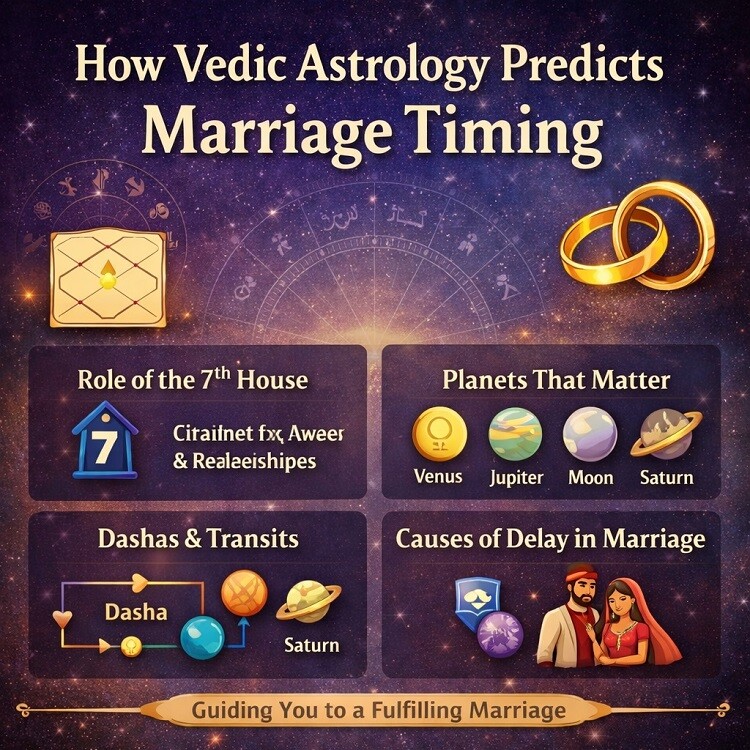
Role of the 7th House in Marriage Prediction

In Vedic astrology, the 7th house represents marriage, partnerships, and committed relationships.

Astrologers examine:

  • The condition of the 7th house
  • The ruling planet of the 7th house
  • Planets placed in or aspecting the 7th house

A strong and well-supported 7th house usually indicates timely marriage, while afflictions may cause delays or challenges.


Planets Responsible for Marriage Timing

Several planets influence marriage timing:

Venus

Venus is the primary planet of love and relationships. Its strength and placement play a major role in marriage prospects.

Jupiter

Jupiter signifies growth, blessings, and social commitment. A favorable Jupiter often brings marriage opportunities.

Moon

The Moon represents emotional readiness. Mental preparedness is just as important as planetary support.

Saturn

Saturn can delay marriage, but delays are not always negative. Saturn often brings maturity and long-term stability when marriage happens later.

Marriage timing is assessed by understanding how these planets interact with the 7th house.


Dashas and Transits That Trigger Marriage

Planetary Dashas

Dashas indicate life phases ruled by specific planets. Marriage is more likely when:

  • The Dasha of the 7th house lord
  • Venus or Jupiter Dasha
  • Favorable sub-periods (Antardasha)

Planetary Transits

Transits activate potential shown in the birth chart. Even if marriage is promised in the chart, it often occurs when:

  • Jupiter transits the 7th house or aspects it
  • Saturn supports long-term commitment
  • Venus transit aligns positively

Dashas show when marriage is possible, and transits decide when it actually happens.


Reasons for Delay in Marriage According to Astrology

Marriage delays are common and do not mean marriage denial.

Some astrological reasons include:

  • Weak or afflicted 7th house
  • Strong Saturn influence
  • Late activation of marriage-related Dashas
  • Emotional unreadiness shown by Moon placement

Understanding the reason behind delay helps reduce anxiety and brings clarity.


Can Astrology Predict the Exact Marriage Date?

Astrology does not usually predict exact calendar dates. Instead, it identifies:

  • Favorable months or years
  • Periods when proposals or relationships may materialize
  • Times when marriage discussions become active

This approach is more realistic and reliable than date-based predictions.


What to Do If Marriage Is Delayed

Astrology offers guidance, not shortcuts.

Helpful steps include:

  • Understanding personal readiness
  • Improving communication and expectations
  • Following simple, suitable remedies if advised
  • Avoiding fear-based or excessive rituals

A balanced mindset combined with right action often brings better results than waiting passively.


How Vedic Astrology Consultation Helps

A personalized Vedic astrology consultation helps identify:

  • Whether marriage is promised in the chart
  • Favorable periods for marriage
  • Causes of delay
  • Practical guidance for improvement

This approach focuses on clarity and confidence, not fear.

To understand the complete process behind astrology guidance, you can explore our Vedic astrology consultation guide.


Final Thoughts

Vedic astrology predicts marriage timing by studying planetary periods, house strength, and life readiness. It does not control destiny but provides timing awareness, helping individuals make informed decisions.

Marriage happens when planetary support aligns with personal growth and emotional preparedness. Astrology simply helps recognize that alignment.

For those seeking personalized guidance beyond general explanations, Astro Shree Somok offers detailed Vedic astrology consultations focused on clarity, realistic insights, and practical direction for important life decisions such as marriage, career, and relationships.